


Defects Exclusions in Contract Works Policies Why the small print matters more than ever — and what's changing.
A Contract Works claim rarely turns on whether there's cover for damage — it turns on the defects exclusion buried in the policy wording. The clause selected, whether DE3, DE4, DE5, LEG2 or LEG3, can be the difference between a claim being paid in full and a client being left to fund a significant shortfall themselves.
With the London Engineering Group (LEG) confirming it will release updated clause wordings by the end of August 2026, this is a timely moment to revisit how these exclusions work and what you should be discussing with your clients.
Two Families of Defects Wordings.
Contract Works markets typically draw on two clause families:
● DE clauses (drafted by the UK CAR Group) — traditionally used for building projects.
● LEG clauses (drafted by the London Engineering Group) — traditionally used for civil, heavily engineered, electrical, mechanical and process engineering projects.
In practice the choice increasingly comes down to insurer and broker preference rather than strict project type, so it's worth knowing both families well.
DE3, DE4 and DE5 — the practical differences.
● DE3 — excludes the cost of repairing the defective property itself (and anything relying on it for support), but pays for damage to other insured property that is free of the defect.
● DE4 — a narrower version of the same idea, limiting the exclusion to the specific defective component or item rather than the wider defective structure.
● DE5 — the broadest of the three. It pays to rectify damage to both the defective and non-defective property; the only thing excluded is the additional cost of improving the original design, materials or workmanship — commonly called "betterment".
LEG2 and LEG3 — the practical differences
● LEG2/96 — broadly mirrors DE3/DE4. It excludes the cost that would have been needed to replace or rectify the defect had it been picked up before any damage occurred, while covering resultant damage to parts of the property that are free of the defect.
● LEG3/06 — the broadest LEG wording. Like DE5, it covers the cost of rectifying damage to both the defective and non-defective portions of the property, excluding only betterment costs.
At a Glance
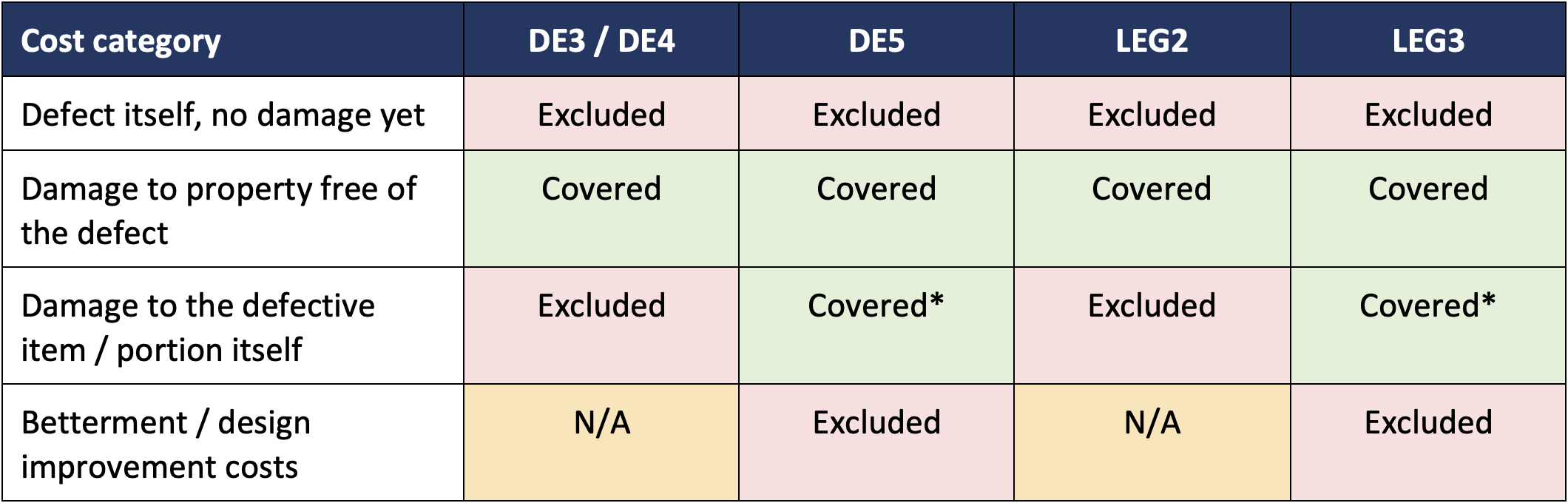
*Cover is net of betterment — insurers still deduct the cost of any improvement to the original design, materials or workmanship.
What's Changing: New LEG Clauses Expected by End of Summer
Speaking at Commercial Risk's Construction Risk Management Europe conference in June 2026, LEG chairman Charlie Dee confirmed that updated LEG1, LEG2 and LEG3 wordings — together with a supporting guidance note — are on track for release by the end of summer 2026.
The update follows several years of uncertainty after a September 2023 US federal court ruling (SCB v Lexington Insurance Company) found the current LEG3/06 wording "egregiously ambiguous," significantly widening the accepted interpretation of LEG3 cover. A further US decision, Archer v Ace, reached a similar conclusion, while a Danish court ruled against a contractor on the same clause in 2025. Between them, the rulings raised real concern in the market that insurers could restrict — or withdraw — LEG3 cover altogether.
LEG has been clear that the intent behind the redraft is clarity, not a change in the scope of cover:
● The primary goal is to remove the "tortuous" language criticised by the US court and reduce the scope for future disputes over interpretation.
● LEG has stated it has deliberately avoided broadening or restricting cover — the new clauses are intended to respond to claims in the same way as the versions they replace.
● The drafting followed a broad market consultation, including major London carriers and brokers, feedback from the IUA's claims committee, loss adjusters, and legal opinion from the UK, US and Australia.
● A broker sits within LEG's working group specifically to help ensure the new wordings preserve the existing level of cover.
What This Means for Your Clients
● Review the defects exclusion on current and upcoming Contract Works placements — DE3/DE4/LEG2 and DE5/LEG3 can produce very different claims outcomes for the same loss.
● Consider deductibles alongside cover level: broader cover under DE5/LEG3 often carries a higher deductible, and in some cases a "DE3(4)/DE5" or "LEG2/LEG3" option can let the client choose the better outcome at claim stage.
● For contractors seeking the broadest cover, insurers are increasingly focused on demonstrable quality control, tender discipline and a track record of delivering similar projects — this is worth factoring into submissions.
● Clients with live claims under the current LEG3/06 wording are not expected to be affected by the new clauses, but it's worth keeping an eye on LEG's guidance note once published.
Talk to Scope Underwriting
Not sure which defects exclusion suits your client's next project?
Get in touch with your usual Scope Underwriting contact — we're happy to talk through DE and LEG options for any upcoming Contract Works submission, and we'll keep you updated as soon as LEG's new wordings and guidance note are published.
